Slate Truck Excluded From Canadian Market Amid Tariff Challenges and Trade Uncertainty
Automaker confirms no plans to export US-made EVs to Canada as trade dynamics reshape availability
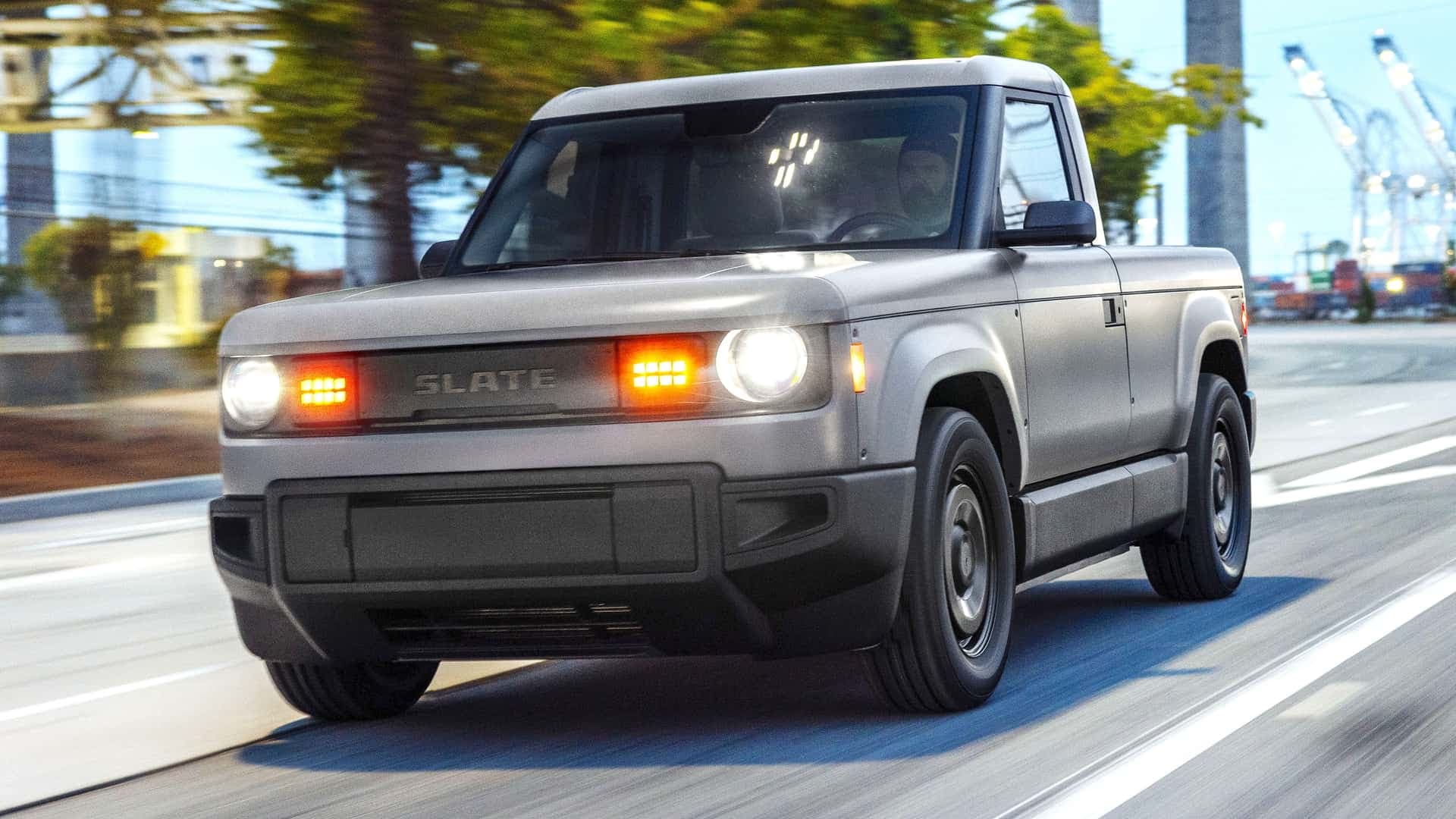
Slate Auto has confirmed that its upcoming electric truck and SUV will not be available for sale in Canada. The announcement was confirmed by a Slate spokesperson to Automotive News Canada, stating that the company does "not have plans to sell vehicles" in the country. The automaker did not provide a specific reason for its decision not to export the vehicles north of the border.
The absence of Slate vehicles in the Canadian market follows the official announcement of the truck's starting price at $24,850 in the United States. The SUV is priced $5,000 higher. Deliveries for both models are scheduled to begin later this year in the US. The company has marketed both the truck and SUV as affordable, bare-bones electric vehicles with a focus on personalization and customer-driven maintenance. Each vehicle is sold with minimal factory features but offers a wide range of accessories, including stereos, seat covers, roof racks, wraps, and other upgrades. Slate owners are promised the ability to repair and upgrade their own vehicles, and the company offers a 10-year, 110,000-mile battery and powertrain warranty. Notably, owners will also be able to convert their trucks into SUVs after the initial purchase.
The Slate truck is equipped with a 65.0-kilowatt-hour lithium-iron-phosphate battery, offering up to 205 miles of range in the pickup configuration. This is an increase from the earlier prototype, which had a 52.7-kWh battery and a 150-mile range. The electric motor produces 181 horsepower, a decrease from the previously stated 201 horsepower, but maintains a torque output of 195 pound-feet. The truck can accelerate from 0 to 60 miles per hour in eight seconds and is capable of towing up to 2,000 pounds.
Industry observers have pointed to tariffs as a likely factor behind Slate's decision not to enter the Canadian market. After the United States, under former President Donald Trump, imposed a 25 percent tariff on imported Canadian vehicles, Canada responded with reciprocal tariffs on American-made cars. These measures have contributed to a more challenging environment for cross-border vehicle sales, particularly for manufacturers aiming to compete on price. According to Motor1.com, the economic reality created by these tariffs makes it difficult for Slate to sell its electric vehicles in Canada at a price point that aligns with its affordability-focused brand positioning.
Another factor contributing to the uncertainty is the status of the United States-Mexico-Canada Agreement (USMCA), a trilateral trade pact signed during Trump's first term. While Canada and Mexico had sought a straightforward 16-year extension of the agreement, the US administration indicated it would not renew the deal in its current form. As a result, the agreement will now be subject to annual reviews for the next decade but will remain in force unless the parties fail to agree on revisions. If no new agreement is reached, the USMCA is set to expire on July 1, 2036. This ongoing uncertainty over future trade arrangements adds a layer of complexity for automakers evaluating long-term plans for market entry and supply chain investments.
For Canadian consumers, the decision means that the anticipated low-cost electric truck and SUV will not be available, at least in the near term. The move also reflects broader trends in North American trade, where retaliatory tariffs and evolving trade agreements can have direct impacts on product availability and pricing. Slate's withdrawal from the Canadian market is emblematic of the ongoing challenges automakers face in an environment characterized by shifting tariff regimes and the renegotiation of long-standing trade pacts.
Slate's approach to vehicle sales emphasizes consumer autonomy and modularity. The company’s promise of easy repairs, upgrades, and the ability to transform the base vehicle into different body styles is positioned as a key differentiator in the electric vehicle market. However, the ability to deliver on these promises at a competitive price is contingent on stable trade conditions and manageable import costs. The current tariff landscape has constrained Slate’s ability to maintain its value proposition outside the US market.
The next decade is expected to bring ongoing reviews and potential renegotiations of cross-border trade agreements, which could further influence the strategies of automakers considering entry into Canada. While the USMCA remains in force for now, the prospect of future changes introduces further uncertainty for manufacturers like Slate, especially those whose business models are predicated on affordability and flexibility.
The situation also highlights the interconnectedness of trade policy and consumer choice in the automotive sector. As governments adjust tariffs and renegotiate trade agreements, the downstream effects are felt by manufacturers, retailers, and ultimately consumers who may face reduced access to certain products or higher prices. Slate’s decision not to enter the Canadian market at this time is one outcome of these broader geopolitical and economic dynamics.
In summary, Slate Auto has opted not to sell its new electric truck and SUV in Canada, a decision likely influenced by reciprocal tariffs between the US and Canada and the uncertain future of the USMCA. The company’s affordable EVs will launch in the US later this year, featuring modular design, user-serviceable components, and a warranty aimed at long-term ownership. Canadian consumers will be unable to purchase the vehicles directly, reflecting the current impact of trade policy and tariff structures on cross-border automotive sales.