Manitoba's Graduating Class of 2026: Reflections and Aspirations
High school graduates across the province share their journeys, challenges, and hopes for the future
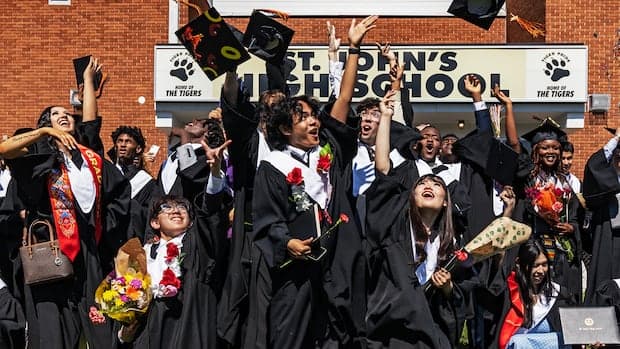
Thousands of high school students across Manitoba are graduating in June 2026, marking the completion of their secondary education and the beginning of new chapters. The experiences and reflections of these graduates illustrate a diverse array of backgrounds, aspirations, and challenges, while highlighting the influence of educators, the arts, and community support systems.
In Garden Hill Anisininew Nation, a remote fly-in community over 450 kilometres northeast of Winnipeg, nearly 30 students graduated from Garden Hill High School. Valedictorian Joshua McPherson encouraged his peers to broaden their horizons and surpass expectations. McPherson's journey included serving on the school council and maintaining high grades despite obstacles such as a school closure in 2022 caused by mould. He attributed a significant part of his early success to the Outside Looking In program, an Indigenous-led dance and mentorship initiative. Through this program, McPherson performed and travelled to Toronto several times, experiences that he described as pivotal. "I was able to really let myself feel for the first time in years through dance," McPherson said. Inspired by these experiences, he plans to attend Toronto Metropolitan University to study psychology in the fall, motivated by the opportunity "to make a difference in other people's lives."
At Niverville High School, southeast of Winnipeg, 19-year-old Sarina Jafari celebrated her graduation as a milestone that held personal and familial significance. Jafari's family left Afghanistan for New Delhi, India, as Christian refugees in 2018 before immigrating to Canada with her mother and two siblings. Reflecting on her arrival in Niverville in July of the previous year, Jafari said, "It was amazing. I felt that I can breathe." The sense of belonging she found in the community was fostered by mentors and teachers, and she shared her story and culture through charcoal drawings and paintings, including those shown at a local art show in January. Some of her artwork addressed the situation of Afghan girls and women, referencing the Taliban's 2021 ban on girls' schooling beyond Grade 6. Jafari emphasized that her graduation was especially important to her family, stating, "my mom never got to graduate. I'm happy to make them feel proud." She intends to take a gap year to obtain a driver's licence, save for university, and travel in Canada before continuing her studies.
Gus Moar, 18, from John Taylor Collegiate in Winnipeg's Crestview area, credited his academic and musical success to both his bandmates and teachers. A four-time honour roll student, Moar played drums and saxophone in several bands, including his own ensemble, Gus Moar Plus Four. He described the importance of these experiences: "It's just great that I'm going to have these memories to look back on when I'm older." Moar performed Gene Krupa's version of "Sing, Sing, Sing" for CBC, explaining, "Feeling the beat as I'm playing … it feels good. Knowing that other people are relying on me, it makes the music feel special." As part of a cohort of approximately 130 John Taylor graduates, Moar participated in a tradition of visiting their former elementary and middle schools before convocation, where younger students cheered them on. Moar reflected on the transition with mixed emotions: "It's exciting, but also kind of scary." He plans to pursue studies in math or music education at university.
At St. John's High School in Winnipeg, over 100 graduates marked their convocation with a ceremony that included an honour song and a procession around a medicine wheel stage. Indigenous students were recognized with star blankets crafted by volunteers. Aeyla Antique, 18, who immigrated from the Philippines as a child, served as valedictorian. She credited the school's career guidance and homework resources for her academic achievements, stating, "It's really important to have people that support you. That's really what we are as a school, as a community, right? And we're always there to uplift each other."
Christian Colombe, 18, also from St. John's, reflected on the support he received from friends and teachers, particularly following the loss of his younger sister in February. "I was quite moved by all the support I got when my [younger] sister passed, and it was quite motivating to keep going … to know all these people had my back." Colombe's family travelled from O-Pipon-Na-Piwin Cree Nation and Thompson in northern Manitoba to celebrate his accomplishments. Having started high school after relocating from Brandon during the pandemic, Colombe played football and rugby during his time at St. John's. He plans to study engineering at university. "I'm really proud that I was able to make a comeback academically," he said. "I'm happy it's over. I'm just sad I'll miss out on teachers and friends from here."
Graduates interviewed by CBC consistently pointed to the support of teachers, mentors, and extracurricular programs as critical factors in their academic and personal development. Several students noted the importance of the arts, with dance and music providing outlets for self-expression and connection.
The Class of 2026 highlighted a range of challenges faced by Manitoba students in recent years. These included school closures due to health and safety issues, the impact of the COVID-19 pandemic on learning environments and social integration, and personal hardships such as family loss and the experience of immigration or displacement.
Students also articulated aspirations shaped by their distinct circumstances. For some, graduation represents not only a personal achievement but also a milestone for their families and communities. The narratives included overcoming adversity, pursuing higher education, and contributing to broader social change, as seen in Jafari's focus on the situation of women in Afghanistan and McPherson's dedication to psychology.
Ceremonies across the province incorporated elements that reflected the diversity of Manitoba's student population. These included honour songs, recognition of Indigenous traditions, and acknowledgements of the support provided by families and communities.
The reflections from the Class of 2026 reveal how individual accomplishments are often intertwined with collective efforts and support systems. As these graduates move on to post-secondary education, work, or travel, they do so with experiences shaped by both challenges and encouragement from those around them.