Manitoba Flooding Emergency Triggers Evacuations and Widespread Infrastructure Damage
Dauphin, Swan River and surrounding communities respond to record rainfall and critical emergency impacts
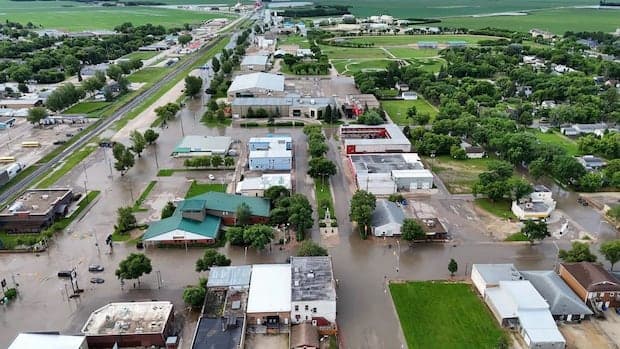
A series of intense rainstorms since late June has led to a state of emergency across large parts of Manitoba’s Parkland region, with the city of Dauphin and the town of Swan River among the hardest hit. Municipal and provincial officials have declared 30 local states of emergency, following what city leaders called an unprecedented rainfall event. Dauphin officials reported approximately 115 millimetres of rain since Sunday night, the majority falling over a short period and overwhelming storm and wastewater systems. This places June 2026 as the second-wettest June on record for Dauphin, with a total of just over 211 millimetres, narrowly below the 216-millimetre record set in 1953.
Mayor David Bosiak of Dauphin described the current flooding as the most severe in his experience: “In my lifetime, there’s been four or five major floods. This is probably — from a city point of view — as bad as I’ve ever seen it in the city of Dauphin.” He noted the Vermillion River, which runs through the city, had likely peaked by midday Wednesday after spilling its banks, flooding Vermillion Park, and sending water toward Dauphin’s lower-lying north end. That area has seen the worst overland flooding and basement damage, affecting both residential and commercial properties. Bosiak reported several businesses along Main Street with flooded basements, and some apartment residents near the river displaced. Homeowners whose electrical panels were affected by basement flooding have also had to leave their homes.
The city of Dauphin has established a command centre at city hall and is directing displaced residents to the Credit Union Place recreation complex for shelter. Municipal officials have urged all residents to avoid non-essential travel and to limit water use, as flooding and overwhelmed infrastructure have closed many streets. The Buckwold Bridge (4th Avenue SW Bridge) is shut to both vehicles and pedestrians. Residents have also been warned that driving through flooded areas can worsen flooding and pose risks to emergency crews. Deputy Mayor Christian Laughland reported community-wide impacts, stating, “I would say everybody in the city of Dauphin is affected in some capacity,” with some basements dry and others inundated by up to five feet of water. Cleanup efforts have begun in areas where water is receding, but pooling persists in other neighbourhoods.
The provincial response has included strong warnings from Premier Wab Kinew, who asked residents to stay off roads, even those that appear passable, due to ongoing infrastructure failures. “We continue to see a lot of road failures and other impacts on infrastructure in the region in areas even where the water may have moved on from its peak,” Kinew said. He specified that travel is not advised from Russell north to Mafeking and from Dauphin Lake west to the Saskatchewan border, and discouraged the use of back roads to circumvent closures. More than 50 provincial roads and numerous municipal roads are blocked or damaged. Christine Stevens, director of Manitoba’s Emergency Management Organization, stated that road and bridge damage is impeding the movement of emergency resources and power restoration efforts.
The Dauphin Regional Health Centre was forced to evacuate 57 patients and one infant after flooding inundated its loading dock and affected emergency generators in the basement, with patients transferred to Brandon and other facilities. The hospital’s emergency department is closed until further notice, while a temporary urgent care centre is being established at the Dauphin Medical Clinic. Premier Kinew emphasized that all necessary measures are being taken to provide medical care, with air and ground transportation coordinated by the Office of the Fire Commissioner, the Medical Transportation Coordination Centre, and other emergency services.
In Swan River, approximately 195 kilometres northwest of Dauphin, mandatory evacuation orders were issued for some neighbourhoods as water levels rose rapidly. About 150 homes have been evacuated after flooding cut off road access, with helicopters deployed to assist in relocating residents to safer areas within the town. The Swan River hospital remains operational. The province is also airlifting approximately 100,000 sandbags and transporting high-volume pumps to Swan River to support flood mitigation efforts.
Surrounding municipalities including the Rural Municipality of Dauphin, Municipality of Gilbert Plains, Municipality of Ste. Rose, Rural Municipality of Lakeshore, and Mossey River Municipality have also declared local states of emergency. Other affected communities include Swan Valley West, Minitonas-Bowsman, Ethelbert, and the Mountain area. Manitoba Hydro reported about 350 customers, mainly in the Parkland region, without power as of Wednesday night, with floodwaters washing away poles and lines. In some cases, helicopter crews are needed to access and repair damage. The utility warned some outages will extend into Thursday.
Fisaha Unduche, executive director of Hydrologic Forecasting and Water Management for Manitoba, stated that some areas received more than 200 millimetres of rain. Although major precipitation is not expected over the following seven days, river levels remain elevated and runoff continues moving through watersheds. Water levels on several reservoirs and lakes, including Shellmouth Reservoir (Lake of the Prairies), Rivers Dam (Lake Wahtopanah), Minnedosa Dam and Dauphin Lake, are forecast to rise by one to three feet in coming days. Unduche indicated that water levels along the Assiniboine River are expected to decline around mid-July.
Residents in affected areas have been asked to shelter in place if possible, provided they are safe and have necessary supplies. “If you are healthy, if you have supplies, please stay home. If you are in a medical emergency, please contact 911 or your local emergency service,” Kinew advised. He also noted that if required, emergency evacuation would be conducted by helicopter, boat, or other necessary means.
The flooding has led to the cancellation of community events, including Dauphin’s Canada Day Party in the Park celebration. The event was cancelled after consideration of indoor alternatives, due to ongoing public safety concerns.
To support affected municipalities, the Manitoba government announced $5 million in cash-flow funding in advance of expected Disaster Financial Assistance (DFA) payments. This funding is intended to help local governments respond to immediate crisis needs and mitigate the fiscal burden. The DFA program had already been announced in response to flooding from an earlier June storm.
Emergency Management Organization director Christine Stevens emphasized that, despite rainfall having stopped in some locations, water levels in rivers remain high and road infrastructure failures are still occurring. She stated, “We’re also prepared to support any additional evacuations that might have to occur in communities that are currently affected.” Officials are working to assist people stranded at Duck Mountain Provincial Park, where access roads are impassable and downed power lines are delaying evacuation. Conservation officers are ensuring that those in the park have adequate supplies until they can be safely escorted out.
Eyewitness accounts have described the scope of the flooding. Mark Symchych, a resident of Dauphin, recounted that by Tuesday afternoon, “the rivers were extremely high and the ditches were full,” with water crossing Highway 5 for about a quarter of a mile. He described seeing farm equipment surrounded by floodwater and city streets nearly impassable.
As of July 2, authorities continued to monitor the situation, with some areas beginning cleanup efforts while others remain at risk from elevated water levels and further infrastructure strain. Officials underscored the need for public cooperation with travel and water-use advisories to allow emergency crews to focus resources on the most critical needs.