Juneau Paddlers Dorn and Nelson Complete Yukon River Quest Amid Challenges and High River Conditions
Team 'Bucking the Tide' finishes seventh overall; 'Skagway Swinging Sixties' wins open voyageur class
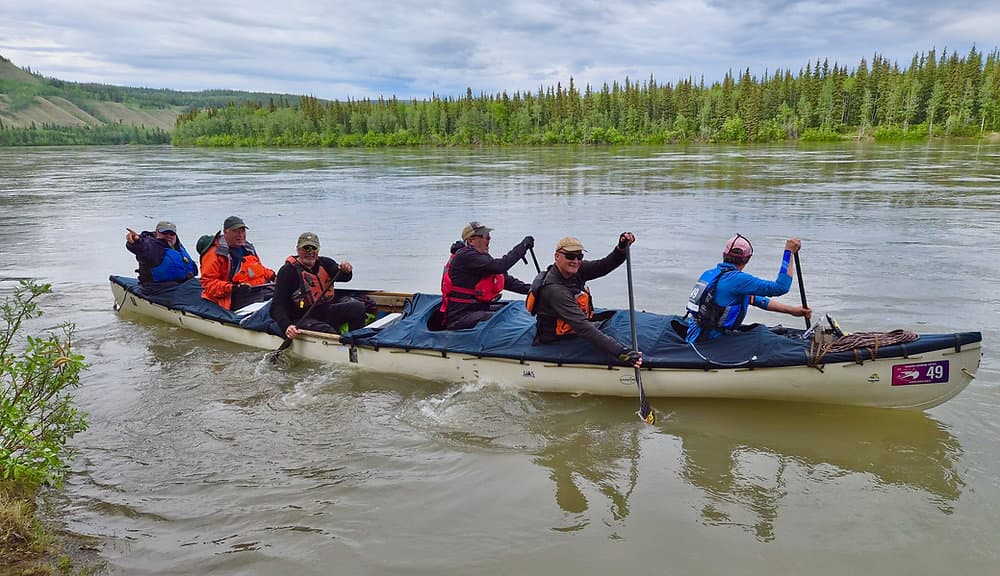
Juneau residents Justin Dorn and Eric Nelson recently participated in the Yukon River Quest, a 444-mile paddle race also known as the "Race to the Midnight Sun." The annual event covers the distance from Whitehorse, Yukon Territory, to Dawson City and features solo and tandem canoes and kayaks, solo stand-up paddle boards (SUPs), as well as larger C4 (four-person) and voyageur (six to 10 people) canoes. The voyageur canoes are rooted in the 18th and 19th-century practices of French-Canadian fur traders.
Justin Dorn raced as part of the C4 canoe team "Bucking the Tide," which included Colorado-based Harlan Nimmo, John Seelig, and Seth Mason. The team completed the race in 47 hours, 31 minutes, and 12 seconds, placing seventh overall and first among U.S. teams. Dorn described the race as involving significant physical and environmental challenges, such as a broken seat, lightning storms, rain, waves over the boat, whiteout fog, fatigue, and mosquitoes. He cited sleep deprivation as a key difficulty, recounting an episode where a teammate, an EMT/firefighter, insisted on caffeine to prevent Dorn from falling asleep and potentially creating a safety hazard.
Eric Nelson competed with the "Skagway Swinging Sixties," a voyageur canoe team consisting of Skagway paddlers Jeff Brady, Tim Bourcy, Michael Yee, Dennis Bousson, and Mike Korsmo. Each member was in their 60s, with an average age of 66 and a half, as noted by team captain Jeff Brady, age 69. The team finished 27th overall, completing the race in 53 hours, 4 minutes, and 59 seconds, and took first place in the open voyageur class. Brady attributed some of their success to their collective knowledge of the river and favourable river conditions, which allowed them to manage their physical exertion and navigate challenges such as storms.
Approximately 300 miles into the race, at Coffee Point, the "Skagway Swinging Sixties" joined with another team, "Skagway Stoke Boat" (Nicole Kovacs, Jesse Guilliams, Jen Larsen, Alexandra Brontë Luqué, Stephanie Hawney Caldwell, and Sam Best). Skagway Stoke Boat finished 23rd overall and second in the mixed voyageur class with a time of 51:45:43.
The Yukon River Quest originated as a centennial commemoration called the Dyea to Dawson, a reenactment of the 1897-1898 Klondike Gold Rush route. The original event combined a 50-pound pack haul over the Chilkoot Trail with canoeing, but trail wear led organizers to focus exclusively on the river segment after 1997 and 1998.
Dorn described the cognitive effects of exhaustion, including visual hallucinations such as mistaking floating logs for animals and, in one instance, perceiving a dragon. Another racer recounted seeing sunrise reflections morph into dolphins and a cage with a beckoning woman. Teams adopted strategies to manage nutrition and hydration, with Dorn's team setting a 30-minute timer for fueling and breaks, using a mix of gels, sports drinks, sandwiches, and sweet potatoes. Equipment for the unsupported race included firestarters, emergency bivvies, flotation devices, tents, sleeping bags, and rain gear, with individual and team safety prioritized.
In terms of crew assignments, Dorn explained that the stern (seat four) is typically occupied by the best river navigator, while the bow (seat one) sets the tempo. Middle seats are reserved for the strongest paddlers. Dorn occupied seat two in a team where all members had substantial river experience. Harlan Nimmo is an EMT/firefighter and veteran of endurance canoe races. John Mark Seelig and Seth Mason were members of the U.S. national whitewater rafting team and had attempted the Grand Canyon downriver record. Dorn and Mason's connection dated back to their youth in Juneau, with family ties influencing both their personal and athletic trajectories.
The race requires a mandatory 10-hour layover at Carmacks, where teams are permitted support. Checkpoints along the route require racers to report their entry numbers to officials, and time limits are in place for each checkpoint. Dorn experienced equipment failure when his seat broke and the slider malfunctioned, causing discomfort and instability until he improvised a solution using padding to relieve pressure. He reported significant pain but managed to complete the race after adapting his setup during the layover.
Environmental conditions varied along the route. The Five Finger Rapids, the only whitewater section, demand precise navigation through channels formed by basalt columns. Brady described encountering a storm while in a favourable river position, allowing his team to don rain gear quickly and continue while others were forced to stop. Brady noted that high water at Teslin was advantageous and that his team used a shortcut to avoid fog at Fort Selkirk.
The Yukon River Quest had been cancelled at Carmacks for two consecutive years, 2024 and 2025, due to forest fires. Dorn stated that he had trained for about a year for the event, shifting focus from cardiovascular conditioning to strengthening shoulders and back—areas he identified as limiting factors after previous experience. He adapted his training with rowing machines and simulated paddling, and described the event as a departure from his usual athletic pursuits, which include triathlons.
Dorn, who works as a physical therapist, emphasized the importance of teamwork and adaptability, noting the need for humility and the willingness to undertake unfamiliar challenges. He reflected on his sporting background and family connections as influences on his participation. Both Dorn and Brady highlighted the importance of team cohesion and mutual support during periods of fatigue and adversity, with strategies such as storytelling, regular check-ins, and humour helping to maintain morale.
Nutrition, safety, and navigation were recurring themes for both teams. Dorn's group, for instance, was vigilant about checking on members who grew quiet or appeared to struggle. Brady noted that experience and local knowledge contributed to their approach, including shortcutting in fog and optimizing their route during high water. The presence of floating debris, challenging weather, and wildlife added to the complexity of the race.
The Yukon River Quest remains a significant endurance event, linking modern adventure racing with the region's historical legacy and requiring participants to adapt to variable river conditions and logistical demands. The performance of Dorn, Nelson, and their teams in 2024 reflects both the ongoing appeal of the event and the skills required to complete it successfully.