Cascadia Minerals Expands Sulphide Mineralization at Carmacks Project in Yukon
2026 drill campaign delivers significant step-outs, resource growth potential and new exploration targets
Cascadia Minerals Ltd. has released the initial results from its 2026 exploration program at the Carmacks copper-gold project in central Yukon, reporting the largest drill campaign on the property since 2007 and the first significant effort aimed at expanding sulphide resources. The project, which is accessible by road and situated within the Traditional Territory of the Little Salmon Carmacks and Selkirk First Nations, covers 180 square kilometres within the Minto Copper Belt, approximately 35 kilometres southeast of the past-producing Minto Mine.
As of July 2026, Cascadia has completed 16 holes totalling 8,226 metres out of a planned 15,000-metre program, with crews on track to complete the full campaign this season. The focus of recent drilling has been on Zone 147 and Zone 2000S, alongside initial tests at the Gap Zone and the previously undrilled Sourtoe target. The drilling campaign represents a shift from historical work, which primarily targeted oxide copper mineralization, by focusing on expanding known sulphide zones.
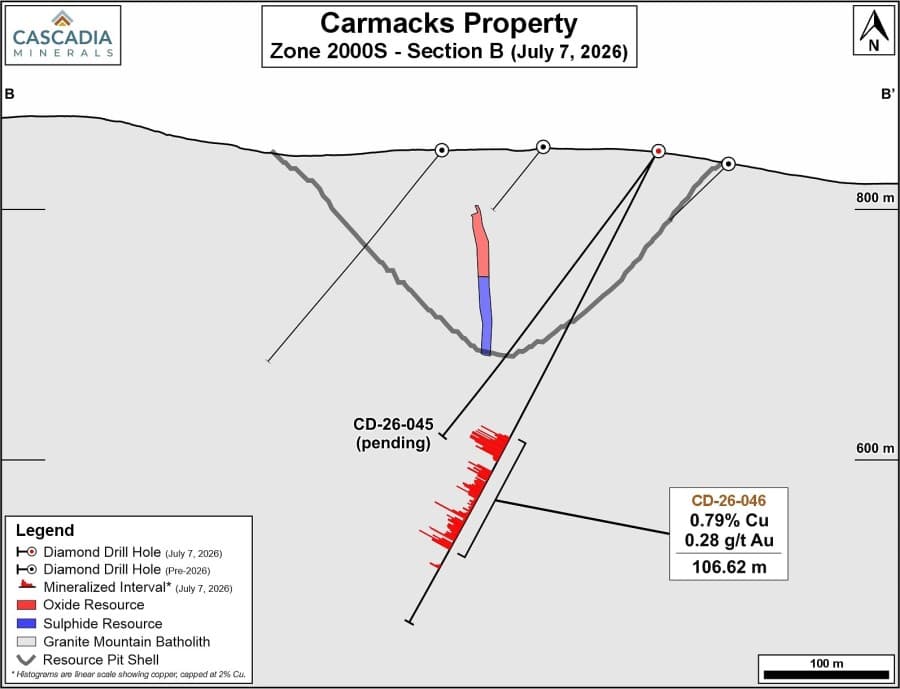
Highlights from the initial batch of assay results include hole CD-26-046 at Zone 2000S, which intersected 106.62 metres grading 0.79% copper and 0.28 grams per tonne (g/t) gold (1.09% copper equivalent), including a higher-grade section of 23.15 metres at 1.42% copper and 0.51 g/t gold (1.94% copper equivalent). This hole extended Zone 2000S by 60 metres to the north, with mineralization remaining open at depth and along strike. Additional step-out drilling has extended testing of Zone 2000S a further 50 metres north, reaching a total of 111 metres beyond previous drilling, and at greater depths, with results from these holes pending.
In Zone 147, hole CD-26-041 returned 98.16 metres of 0.92% copper and 0.11 g/t gold (1.06% copper equivalent), including 21.24 metres grading 2.38% copper and 0.30 g/t gold (2.82% copper equivalent). This interval was both wider and higher grade than predicted by the existing resource model for the area. The first 50 metres of the intercept is in oxide material, with the remainder transitioning to sulphide mineralization. Other holes in this batch tested extensions and gaps in historical drilling at Zone 147 and the Gap Zone, yielding intervals including 64.76 metres of 0.41% copper and 0.10 g/t gold (0.55% copper equivalent) in hole CD-26-044.
In addition to the main zones, holes CD-26-051 and CD-26-053 targeted the Sourtoe area, located one kilometre west of Zone 147. These holes encountered several rafts of migmatized rock but limited mineralization, with assay results pending. Other holes at Zone 2000S, notably hole CD-26-056, encountered mineralization up to 111 metres north of previously drilled extents, and hole CD-26-054 intersected the deepest mineralization recorded to date at a vertical extent of 467 metres from surface. Most assay results for these and other recent holes are pending and will be released upon completion of analysis.
The Carmacks deposit consists of three primary mineralized zones—147, 2000S, and 1213—each coming to surface and remaining open for expansion. The zones are characterized by 'rafts' of variably migmatized xenolithic meta-sedimentary and meta-volcanic rocks, hosted within granitoids of the Granitoid Mountain Batholith suite. Sulphide mineralization is largely confined to these metamorphic rafts, occurring as chalcopyrite-bornite foliation-parallel stringers and net-textured clots, with sharp, unaltered contacts against the granite intrusions.
Resource estimates for Carmacks, as of the most recent technical assessment, include a Measured and Indicated Resource of 36.3 million tonnes grading 0.81% copper, 0.26 g/t gold, 3.23 g/t silver, and 0.01% molybdenum, totalling 651 million pounds of copper and 302,000 ounces of gold (1.07% copper equivalent). Inferred Resources stand at 2.9 million tonnes grading 0.60% copper, 0.16 g/t gold, 2.34 g/t silver, and 0.02% molybdenum, equating to 38 million pounds of copper and 13,000 ounces of gold.
A preliminary economic assessment (PEA) completed in 2023 indicated positive economic potential for the project, with a post-tax net present value (NPV) of $230.4 million and a 29% internal rate of return (IRR) at base case prices of US$3.75 per pound copper and US$1,800 per ounce gold. An alternative scenario at higher prices—US$4.25 per pound copper and US$2,000 per ounce gold—yielded a post-tax NPV of $330.1 million and a 38% IRR. The assessment noted that these results are preliminary and based in part on inferred resources, which are considered too speculative for classification as mineral reserves under current standards.
Cascadia's exploration at Carmacks is supported by an existing 40-person camp, road infrastructure, and proximity (10 kilometres) to grid power. The project area is situated within the broader Stikine Terrane, a region known for its copper-gold porphyry mineralization and home to several significant deposits in British Columbia. The Minto Copper Belt, in which Carmacks resides, is a 180-by-60 kilometre belt of intrusion-related copper-gold-silver deposits.
Sample analysis for the 2026 drilling campaign was conducted by ALS Canada Ltd., with sample preparation in Whitehorse, Yukon and geochemical analysis in North Vancouver, British Columbia. Quality assurance protocols included the use of certified standards, duplicates, and blanks. Analytical procedures included fire assay for gold and multi-element analysis by four-acid digestion followed by inductively coupled plasma spectroscopy. Copper equivalent calculations for reporting purposes used metal prices of US$4.00 per pound copper, US$2,500 per ounce gold, US$30 per ounce silver, and US$20 per pound molybdenum, with recovery factors based on projections from the Carmacks PEA.
Cascadia has indicated that step-out drilling will continue at Zones 2000S and 147, and that expansion drilling at Zone 1213—an area with primarily shallow historical holes—will commence shortly. Regional exploration efforts are also underway, with initial results identifying a new high-priority target for additional follow-up work. All holes drilled at Zones 147 and 2000S in the current campaign have intersected mineralization, and Cascadia expects to release further assay results as they are received and compiled.
Graham Downs, President and CEO of Cascadia, stated that the campaign has achieved its initial objectives, particularly in terms of extending mineralization beyond the existing resource model. Downs noted that the 2026 program represents a significant step in targeting sulphide resource growth at Carmacks. The technical information provided in Cascadia's recent updates has been reviewed and approved by Thomas Hawkins, Vice President of Exploration and a qualified person as defined under National Instrument 43-101.
The Carmacks Project is one of several assets within Cascadia's portfolio, which also includes exploration partnerships targeting new gold-copper porphyry discoveries in the Yukon segment of the Stikine Terrane. The company’s strategic alliance with Agnico Eagle extends exploration focus across the region, which is considered underexplored compared to neighbouring areas in British Columbia.
The Carmacks project is adjacent to the Minto Mine, recently acquired by Selkirk Copper Mines Inc., further highlighting the region’s ongoing mining activity and potential for future development. The results and ongoing work at Carmacks are being closely monitored by both industry participants and regional stakeholders, including First Nations whose traditional territories encompass the project area.
Cascadia continues to caution that forward-looking information is subject to various risks and uncertainties, and that actual outcomes may differ from those anticipated in its public disclosures. The company has committed to providing updates as further results become available and as its 2026 exploration program progresses.